Anti-Obesity and Anti-Diabetic Potential of Fermented Terengganu Cherry Juice
DOI:
https://doi.org/10.54987/jobimb.v13i1.1091Keywords:
3T3-L1, Adipogenesis, Alpha-amylase, Alpha-glucosidase, Cell differentiationAbstract
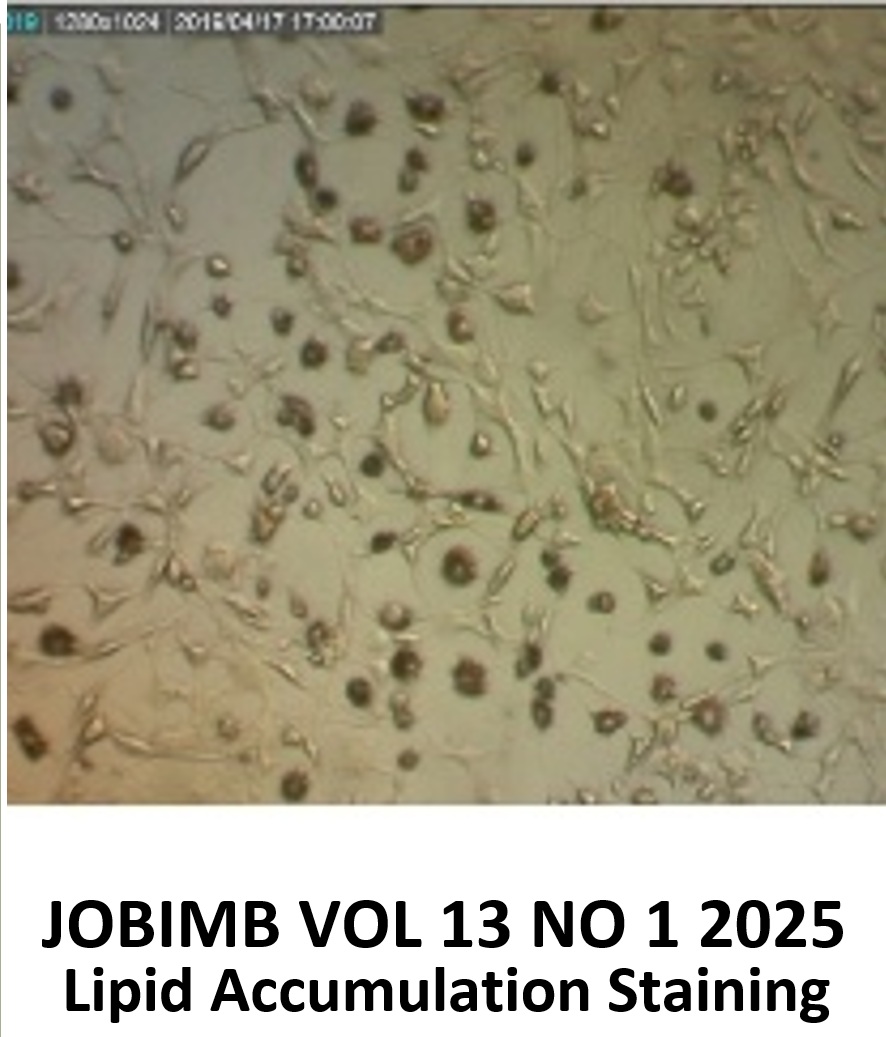
As readily available medications for obesity and diabetes are reported to cause unwanted side effects, many natural alternatives to control obesity and diabetes are brought forward. Terengganu cherry (Lepisanthes fruticosa (Roxb.) Leenh) is an underutilized fruit in Malaysia that has limited study on its health benefits. Hence, this study aims to investigate the potential anti-obesity and anti-diabetic properties of fermented juice extract of Terengganu cherry (FTCJ). For anti-obesity effects, the impact of FTCJ and PTCJ on adipogenesis was assessed using 3T3-L1 cell differentiation assays. FTCJ inhibited lipid accumulation by 50.45%, 48.40%, and 67.12% at concentrations of 0.25 mg/mL, 0.5 mg/mL, and 0.75 mg/mL, respectively. Although PTCJ exhibited greater lipid accumulation reduction than FTCJ, this effect may be attributed to its cytotoxicity, as observed in cytotoxicity assays. For anti-diabetic effects, α-amylase and α-glucosidase inhibition assays were conducted. Both FTCJ and PTCJ showed no inhibitory activity against α-amylase. However, PTCJ demonstrated significantly higher α-glucosidase inhibition (99.11%) compared to FTCJ (31.72%) at 1.0 mg/mL. These findings suggest that while PTCJ exhibits stronger effects in both adipogenesis inhibition and α-glucosidase inhibition, its potential cytotoxicity raises concerns. In contrast, FTCJ exhibits promising anti-obesity effects with lower cytotoxicity, highlighting its potential as a natural alternative for managing obesity and diabetes. Further studies are recommended to explore its mechanisms and potential applications.
References
Institute for Public Health (IPH). Technical Report National Health and Morbidity Survey (NHMS) 2022: Adolescent Health Survey, Malaysia. Kuala Lumpur: Ministry of Health Malaysia; 2022.
Institute for Public Health (IPH). National Health and Morbidity Survey (NHMS) 2023. Kuala Lumpur: Ministry of Health Malaysia; 2023.
Wang LC, Pan TM, Tsai TY. Lactic acid bacteria-fermented product of green tea and Houttuynia cordata leaves exerts anti-adipogenic and anti-obesity effects. J Food Drug Anal. 2018;26(3):973-84. https://doi.org/10.1016/j.jfda.2017.11.009
Sharma BR, Kim DW, Rhyu DY. Korean Chungtaejeon tea extract attenuates weight gain in C57BL/6J-Lep ob/ob mice and regulates adipogenesis and lipolysis in 3T3-L1 adipocytes. J Integr Med. 2017;15(1):56-63. https://doi.org/10.1016/S2095-4964(17)60321-2
Sharma BR, Oh J, Kim HA, Kim YJ, Jeong KS, Rhyu DY. Anti-obesity effects of the mixture of Eriobotrya japonica and Nelumbo nucifera in adipocytes and high-fat diet-induced obese mice. Am J Chin Med. 2015;43(4):681-94. https://doi.org/10.1142/S0192415X15500421
Ali AT, Hochfeld WE, Myburgh R, Pepper MS. Adipocyte and adipogenesis. Eur J Cell Biol. 2013;92(6-7):229-36. https://doi.org/10.1016/j.ejcb.2013.06.001
Liu Y, Peng WQ, Guo YY, Liu Y, Tang QQ, Guo L. Krüppel-like factor 10 (KLF10) is transactivated by the transcription factor C/EBP? and involved in early 3T3-L1 preadipocyte differentiation. J Biol Chem. 2018;293(36):14012-21. https://doi.org/10.1074/jbc.RA118.004401
Rosli NSA, Abd Gani S, Khayat ME, Zaidan UH, Ismail A, Abdul Rahim MBH. Short-chain fatty acids: possible regulators of insulin secretion. Mol Cell Biochem. 2023;478(2):517-30. https://doi.org/10.1007/s11010-022-04528-8
Zatterale F, Longo M, Naderi J, Raciti GA, Desiderio A, Miele C, Beguinot F. Chronic adipose tissue inflammation linking obesity to insulin resistance and type 2 diabetes. Front Physiol. 2020;10:1607. https://doi.org/10.3389/fphys.2019.01607
Kumar M, Kaushik D, Kaur J, Proestos C, Oz F, Oz E, Gupta P, Kundu P, Kaur A, Anisha A, Ritika R. A critical review on obesity: Herbal approach, bioactive compounds, and their mechanism. Appl Sci. 2022;12(16):8342. https://doi.org/10.3390/app12168342
Jakab J, Miški? B, Mikši? Š, Jurani? B, ?osi? V, Schwarz D, V?ev A. Adipogenesis as a potential anti-obesity target: a review of pharmacological treatment and natural products. Diabetes Metab Syndr Obes. 2021;14:67-83. https://doi.org/10.2147/DMSO.S281186
Hussain Zaki UK, Salahuddin MAH. Proximate composition of Malaysian underutilised fruits. J Trop Agric Food Sci. 2014;42(1):63-72.
Marsh AJ, Hill C, Ross RP, Cotter PD. Fermented beverages with health-promoting potential: Past and future perspectives. Trends Food Sci Technol. 2014;38(2):113-24. https://doi.org/10.1016/j.tifs.2014.05.002
Isa JK, Razavi SH. Characterization of Lactobacillus plantarum as a potential probiotic in vitro and use of a dairy product (yogurt) as food carrier. Appl Food Biotechnol. 2017;4(1):11-8. https://doi.org/10.22037/afb.v4i1.13738
Hasmadi H, Mazlina AM, Siti M, Rahman J, Mohamed SA. Potential of fermented kuini and ceri Terengganu beverages in enhancing insulin secretion in pancreatic cells. Food Res. 2023;6(Suppl 2):292-302. https://doi.org/10.26656/fr.2017.6(S2).28
Gani MBA, Nasiri R, Hamzehalipour Almaki J, Majid FAA, Marvibaigi M, Amini N, Chermahini SH, Mashudin M. In vitro antiproliferative activity of fresh pineapple juices on ovarian and colon cancer cell lines. Int J Pept Res Ther. 2015;21(4):353-64. https://doi.org/10.1007/s10989-015-9462-z
Kowalska K, Olejnik A, Rychlik J, Grajek W. Cranberries (Oxycoccus quadripetalus) inhibit adipogenesis and lipogenesis in 3T3-L1 cells. Food Chem. 2014;148:246-52. https://doi.org/10.1016/j.foodchem.2013.10.032
Wickramaratne MN, Punchihewa JC, Wickramaratne DBM. In-vitro alpha amylase inhibitory activity of the leaf extracts of Adenanthera pavonina. BMC Complement Altern Med. 2016;16:466. https://doi.org/10.1186/s12906-016-1452-y
Qaisar MN, Chaudhary BA, Sajid MU, Hussain N. Evaluation of ?-glucosidase inhibitory activity of dichloromethane and methanol extracts of Croton bonplandianum Baill. Trop J Pharm Res. 2014;13(11):1833-6. https://doi.org/10.4314/tjpr.v13i11.9
Liu J, Zhang W, Jing H, Popovich DG. Bog bilberry (Vaccinium uliginosum L.) extract reduces cultured Hep-G2, Caco-2, and 3T3-L1 cell viability, affects cell cycle progression, and has variable effects on membrane permeability. J Food Sci. 2010;75(2):H103-7. https://doi.org/10.1111/j.1750-3841.2010.01546.x
Khoo HE, Azlan A, Tang ST, Lim SM. Anthocyanidins and anthocyanins: colored pigments as food, pharmaceutical ingredients, and the potential health benefits. Food Nutr Res. 2017;61(1):1361779. https://doi.org/10.1080/16546628.2017.1361779
Reis BAD, Kosi?ska-Cagnazzo A, Schmitt R, Andlauer W. Fermentation of plant material - effect on sugar content and stability of bioactive compounds. Pol J Food Nutr Sci. 2014;64(4):235-41. https://doi.org/10.2478/pjfns-2013-0017
Pérez-Gregorio MR, Regueiro J, Alonso-González E, Pastrana-Castro LM, Simal-Gándara J. Influence of alcoholic fermentation process on antioxidant activity and phenolic levels from mulberries (Morus nigra L.). LWT. 2011;44(7):1793-801. https://doi.org/10.1016/j.lwt.2011.03.007
Aranaz P, Navarro-Herrera D, Zabala M, Miguéliz I, Romo-Hualde A, López-Yoldi M, Martínez JA, Vizmanos JL, Milagro FI, González-Navarro CJ. Phenolic compounds inhibit 3T3-L1 adipogenesis depending on the stage of differentiation and their binding affinity to PPAR?. Molecules. 2019;24(6):1045. https://doi.org/10.3390/molecules24061045
Blanco J, Guardia-Escote L, Mulero M, Basaure P, Biosca-Brull J, Cabré M, Colomina MT, Domingo JL, Sánchez DJ. Obesogenic effects of chlorpyrifos and its metabolites during the differentiation of 3T3-L1 preadipocytes. Food Chem Toxicol. 2020;137:111171. https://doi.org/10.1016/j.fct.2020.111171
Kang I, Lee Y, Lee M. Anthocyanins: What they are and how they relate to obesity prevention. In: Watson RR, De Meester F, editors. Nutrition in the prevention and treatment of abdominal obesity. San Diego: Elsevier; 2019. p. 409-30. https://doi.org/10.1016/B978-0-12-816093-0.00028-9
Xie F, Zhang W, Gong S, Gu X, Lan X, Wu J, Wang Z. Investigating lignin from Canna edulis ker residues induced activation of ?-amylase: kinetics, interaction, and molecular docking. Food Chem. 2019;271:62-9. https://doi.org/10.1016/j.foodchem.2018.07.153
Zhang J, Cui JH, Yin T, Sun L, Li G. Activated effect of lignin on ?-amylase. Food Chem. 2013;141(3):2229-37. https://doi.org/10.1016/j.foodchem.2013.05.047
Vinardell M, Mitjans M. Lignins and their derivatives with beneficial effects on human health. Int J Mol Sci. 2017;18(6):1219. https://doi.org/10.3390/ijms18061219
Nawirska A, Kwa?niewska M. Dietary fibre fractions from fruit and vegetable processing waste. Food Chem. 2005;91(2):221-5. https://doi.org/10.1016/j.foodchem.2003.10.005
Oliveira EIS, Santos JB, Gonçalves APB, Mattedi S, José NM. Characterization of the rambutan peel fiber (Nephelium lappaceum) as a lignocellulosic material for technological applications. Chem Eng Trans. 2016;50:391-6. https://doi.org/10.3303/CET1650066
Kalita D, Holm DG, LaBarbera DV, Petrash JM, Jayanty SS. Inhibition of ?-glucosidase, ?-amylase, and aldose reductase by potato polyphenolic compounds. PLoS One. 2018;13(1):e0191025. https://doi.org/10.1371/journal.pone.0191025
Zhang AJ, Rimando AM, Mizuno CS, Mathews ST. ?-Glucosidase inhibitory effect of resveratrol and piceatannol. J Nutr Biochem. 2017;47:86-93. https://doi.org/10.1016/j.jnutbio.2017.05.008
Zhu J, Zhang B, Wang B, Li C, Fu X, Huang Q. In-vitro inhibitory effects of flavonoids in Rosa roxburghii and R. sterilis fruits on ?-glucosidase: effect of stomach digestion on flavonoids alone and in combination with acarbose. J Funct Foods. 2019;54:13-21. https://doi.org/10.1016/j.jff.2019.01.009
Zhang Y, Wong AIC, Wu J, Abdul Karim NB, Huang D. Lepisanthes alata (Malay cherry) leaves are potent inhibitors of starch hydrolases due to proanthocyanidins with high degree of polymerization. J Funct Foods. 2016;25:568-78. https://doi.org/10.1016/j.jff.2016.06.035
Wang M, Mao H, Chen J, Li Q, Ma W, Zhu N, Qi L, Wang J. Chinese bayberry (Myrica rubra Sieb. et Zucc.) leaves proanthocyanidins alleviate insulin-resistance via activating PI3K/AKT pathway in HepG2 cells. J Funct Foods. 2022;99:105297. https://doi.org/10.1016/j.jff.2022.105297
Zhu W, Khalifa I, Wang R, Li C. Persimmon highly galloylated tannins in vitro mitigated ?-amylase and ?-glucosidase via statically binding with their catalytic-closed sides and altering their secondary structure elements. J Food Biochem. 2020;44(8):e13234. https://doi.org/10.1111/jfbc.13234
Torres-Naranjo M, Suárez A, Gilardoni G, Cartuche L, Flores P, Morocho V. Chemical constituents of Muehlenbeckia tamnifolia (Kunth) Meisn (Polygonaceae) and its in vitro ?-amylase and ?-glucosidase inhibitory activities. Molecules. 2016;21(11):1461. https://doi.org/10.3390/molecules21111461
Cardullo N, Muccilli V, Pulvirenti L, Cornu A, Pouységu L, Deffieux D, Quideau S, Tringali C. C-glucosidic ellagitannins and galloylated glucoses as potential functional food ingredients with anti-diabetic properties: a study of ?-glucosidase and ?-amylase inhibition. Food Chem. 2020;313:126099. https://doi.org/10.1016/j.foodchem.2019.126099
Downloads
Published
Issue
Section
License
Copyright (c) 2025 Nur Suraya Ashikin Rosli, Uswatun Hasanah Zaidan, Mohd Ezuan Khayat, Muhajir Hamid, Mohd Badrin Hanizam Abdul Rahim

This work is licensed under a Creative Commons Attribution 4.0 International License.
Authors who publish with this journal agree to the following terms:
- Authors retain copyright and grant the journal right of first publication with the work simultaneously licensed under a Creative Commons Attribution License (http://creativecommons.org/licenses/by/4.0) that allows others to share the work with an acknowledgement of the work's authorship and initial publication in this journal.
- Authors are able to enter into separate, additional contractual arrangements for the non-exclusive distribution of the journal's published version of the work (e.g., post it to an institutional repository or publish it in a book), with an acknowledgement of its initial publication in this journal.
- Authors are permitted and encouraged to post their work online (e.g., in institutional repositories or on their website) prior to and during the submission process, as it can lead to productive exchanges, as well as earlier and greater citation of published work (See The Effect of Open Access).