Potential Antiobesity and Anti-Diabetic Properties of Fermented Kuini (Mangifera odorata) Juice
DOI:
https://doi.org/10.54987/jobimb.v13i1.1054Keywords:
3T3-L1, Adipogenesis, Alpha-amylase, Alpha-glucosidase, Cell differentiationAbstract
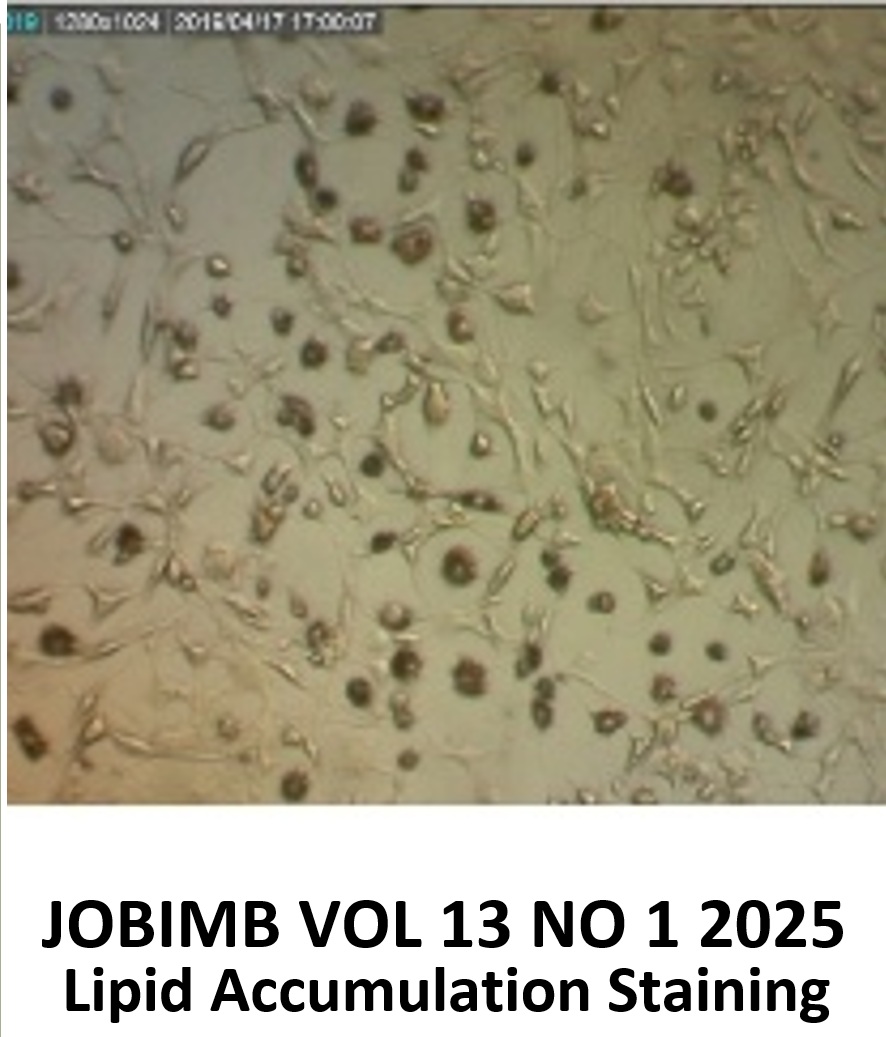
Obesity and diabetes are strongly linked and increase the risk of other critical diseases such as cardiovascular disease, which is highly prevalent today. Currently available synthetic anti-diabetic drugs often cause gastrointestinal side effects, highlighting the need for alternative treatments derived from natural resources, which tend to have fewer side effects and are generally safer. The kuini fruit (Mangifera odorata) has been shown to exhibit high antioxidant activity. However, as an underutilized fruit, there is a lack of studies on its potential health benefits, particularly its antiobesity and anti-diabetic properties. Due to the high demand for rich constituents of bioactive compounds, fermentation is considered a viable method to enhance the nutritional value of this fruit. This study evaluates the potential health benefits of fermented kuini (FK) as an antiobesity and anti-diabetic agent through adipogenesis inhibition in vitro using the 3T3-L1 preadipocyte cell line, as well as its inhibition of α-amylase and α-glucosidase activities. A cell viability assay was conducted to assess the toxicity of different sample concentrations. It was found that concentrations below 1.5 mg/mL did not exhibit cytotoxicity, while higher concentrations reduced cell viability. Fermented kuini (FK) showed lower adipogenesis inhibition compared to pasteurized kuini (PK). The highest inhibition of α-amylase activity was observed at 1.0 mg/mL FK, with a percentage inhibition of 41.6%. Similarly, the highest inhibition of α-glucosidase activity was observed at the same concentration, with a percentage inhibition of 39.0%. Based on the data generated, FK demonstrates potential antiobesity and anti-diabetic properties and could serve as an alternative strategy for managing obesity and diabetes.
References
Gooda Sahib N, Saari N, Ismail A, Khatib A, Mahomoodally F, Abdul Hamid A. Plants' Metabolites as Potential Antiobesity Agents. Sci World J. 2012;2012:1-8.
Mirfat AHS, Salma I, Razali M. Natural antioxidant properties of selected wild Mangifera species in Malaysia. 2016 [cited 2024 Dec 4]; Available from: http://jtafs.mardi.gov.my/jtafs/44-1/natural.pdf
World Health Organization. Global status report on noncommunicable diseases 2014 [Internet]. Geneva: World Health Organization; 2014 [cited 2024 Dec 4]. 280 p. Available from: https://iris.who.int/handle/10665/148114
Hsu CL, Yen GC. Phenolic compounds: evidence for inhibitory effects against obesity and their underlying molecular signaling mechanisms. Mol Nutr Food Res. 2008 Jan;52(1):53-61.
Ministry of Health, Malaysia. National Health and Morbidity Survey 2015-VOLUME II?: Noncommunicable Diseases, Risk Factors & Other Health Problems [Internet]. ResearchGate. 2024 [cited 2024 Dec 4]. Available from: https://www.researchgate.net/publication/305213149_National_Health_and_Morbidity_Survey_2015-VOLUME_II_Non-Communicable_Diseases_Risk_Factors_Other_Health_Problems
Ng M, Fleming T, Robinson M, Thomson B, Graetz N, Margono C, et al. Global, regional, and national prevalence of overweight and obesity in children and adults during 1980-2013: a systematic analysis for the Global Burden of Disease Study 2013. Lancet Lond Engl. 2014 Aug 30;384(9945):766-81.
Abdullah A, Peeters A, de Courten M, Stoelwinder J. The magnitude of association between overweight and obesity and the risk of diabetes: a meta-analysis of prospective cohort studies. Diabetes Res Clin Pract. 2010 Sep;89(3):309-19.
Dudhia Z, Louw J, Muller C, Joubert E, De Beer D, Kinnear C, et al. Cyclopia maculata and Cyclopia subternata (honeybush tea) inhibits adipogenesis in 3T3-L1 preadipocytes. Phytomedicine. 2013 Mar;20(5):401-8.
Ismail NA, Abu Bakar MF, Abu Bakar FI, Rahim AC, Murdin N. Underutilized Mangifera species (Mangifera caesia, Mangifera quadrifida and Mangifera odorata) from Borneo: a potential source of antioxidant. J Eng Appl Sci. 2019;14(4):1169-77.
Marsh AJ, Hill C, Ross RP, Cotter PD. Fermented beverages with health-promoting potential: Past and future perspectives. Trends Food Sci Technol. 2014 Aug;38(2):113-24.
Isa JK, Razavi SH. Characterization of Lactobacillus plantarum as a Potential Probiotic In vitro and Use of a Dairy Product (Yogurt) as Food Carrier. Appl Food Biotechnol [Internet]. 2017 Jan 4 [cited 2024 Dec 4];4(1). Available from: https://doi.org/10.22037/afb.v4i1.13738
Wang LC, Pan TM, Tsai TY. Lactic acid bacteria-fermented product of green tea and Houttuynia cordata leaves exerts anti-adipogenic and antiobesity effects. J Food Drug Anal. 2018 Jul;26(3):973-84.
Gani MBA, Nasiri R, Hamzehalipour Almaki J, Majid FAA, Marvibaigi M, Amini N, et al. In Vitro Antiproliferative Activity of Fresh Pineapple Juices on Ovarian and Colon Cancer Cell Lines. Int J Pept Res Ther. 2015 Sep;21(3):353-64.
Wickramaratne MN, Punchihewa JC, Wickramaratne DBM. In-vitro alpha amylase inhibitory activity of the leaf extracts of Adenanthera pavonina. BMC Complement Altern Med. 2016 Dec;16(1):466.
Qaisar M, Chaudhary B, Sajid M, Hussain N. Evaluation of ?-glucosidase inhibitory activity of dichloromethane and methanol extracts of Croton bonplandianum Baill. Trop J Pharm Res. 2014 Dec 10;13(11):1833.
Hsu CL, Lo WH, Yen GC. Gallic acid induces apoptosis in 3T3-L1 preadipocytes via a Fas- and mitochondrial-mediated pathway. J Agric Food Chem. 2007 Sep 5;55(18):7359-65.
Aranaz P, Navarro-Herrera D, Zabala M, Miguéliz I, Romo-Hualde A, López-Yoldi M, et al. Phenolic Compounds Inhibit 3T3-L1 adipogenesis Depending on the Stage of Differentiation and Their Binding Affinity to PPAR?. Molecules. 2019 Mar 16;24(6):1045.
Blanco J, Guardia-Escote L, Mulero M, Basaure P, Biosca-Brull J, Cabré M, et al. Obesogenic effects of chlorpyrifos and its metabolites during the differentiation of 3T3-L1 preadipocytes. Food Chem Toxicol. 2020 Mar;137:111171.
Asano H, Kanamori Y, Higurashi S, Nara T, Kato K, Matsui T, et al. Induction of Beige-Like Adipocytes in 3T3-L1 Cells. J Vet Med Sci. 2014;76(1):57-64.
Kang HJ, Seo HA, Go Y, Oh CJ, Jeoung NH, Park KG, et al. Dimethylfumarate suppresses adipogenic differentiation in 3T3-L1 preadipocytes through inhibition of STAT3 activity. PloS One. 2013;8(4):e61411.
Patras A, Brunton N, Da Pieve S, Butler F, Downey G. Effect of thermal and high pressure processing on antioxidant activity and instrumental colour of tomato and carrot purées. Innov Food Sci Emerg Technol. 2009 Jan;10(1):16-22.
Wasila H, Li X, Liu L, Ahmad I, Ahmad S. Peel Effects on Phenolic Composition, Antioxidant Activity, and Making of Pomegranate Juice and Wine. J Food Sci [Internet]. 2013 Aug [cited 2024 Dec 4];78(8). Available from: https://ift.onlinelibrary.wiley.com/doi/10.1111/1750-3841.12204
Kowalska K, Olejnik A, Rychlik J, Grajek W. Cranberries (Oxycoccus quadripetalus) inhibit adipogenesis and lipogenesis in 3T3-L1 cells. Food Chem. 2014 Apr;148:246-52.
Kang I, Lee Y, Lee M. Anthocyanins: What They Are and How They Relate to Obesity Prevention. In: Nutrition in the Prevention and Treatment of Abdominal Obesity [Internet]. Elsevier; 2019 [cited 2024 Dec 4]. p. 409-30. Available from: https://linkinghub.elsevier.com/retrieve/pii/B9780128160930000288
Cheplick S, Kwon YI, Bhowmik P, Shetty K. Phenolic-linked variation in strawberry cultivars for potential dietary management of hyperglycemia and related complications of hypertension. Bioresour Technol. 2010 Jan;101(1):404-13.
Revadigar V, Al-Mansoub MA, Asif M, Hamdan MR, Abdul Majid AMS, Asmawi MZ, et al. Anti-oxidative and cytotoxic attributes of phenolic rich ethanol extract of Musa balbisiana Colla inflorescence. J Appl Pharm Sci [Internet]. 2017 [cited 2024 Dec 4]; Available from: http://www.japsonline.com/abstract.php?article_id=2268
Quan NV, Xuan TD, Tran HD, Thuy NTD, Trang LT, Huong CT, et al. Antioxidant, ?-Amylase and ?-Glucosidase Inhibitory Activities and Potential Constituents of Canarium tramdenum Bark. Molecules. 2019 Feb 9;24(3):605.
Subramanian S, Banu HH, Ramya Bai RM, Shanmugavalli R. Biochemical evaluation of antihyperglycemic and antioxidant nature of Psidium guajava leaves extract in streptozotocin-induced experimental diabetes in rats. Pharm Biol. 2009 Apr;47(4):298-303.
Bray GA, Greenway FL. Current and Potential Drugs for Treatment of Obesity. Endocr Rev. 1999 Dec 1;20(6):805-75.
B D, Mitra A, Manjunatha M. Studies on the anti-diabetic and hypolipidemic potentials of mangiferin (Xanthone Glucoside) in streptozotocin-induced Type 1 and Type 2 diabetic model rats. Int J Adv Pharm Sci. 2010 Mar 12;1(1):75-85.
Rajendran P, Jayakumar T, Nishigaki I, Ekambaram G, Nishigaki Y, Vetriselvi J, et al. Immunomodulatory Effect of Mangiferin in Experimental Animals with Benzo(a)Pyrene-induced Lung Carcinogenesis. Int J Biomed Sci IJBS. 2013 Jun;9(2):68-74.
Downloads
Published
Issue
Section
License
Copyright (c) 2025 Anis Suraya Zabidi, Nur Suraya Ashikin Rosli, Uswatun Hasanah Zaidan, Mohd Ezuan Khayat, Mohd Badrin Hanizam Abdul Rahim

This work is licensed under a Creative Commons Attribution 4.0 International License.
Authors who publish with this journal agree to the following terms:
- Authors retain copyright and grant the journal right of first publication with the work simultaneously licensed under a Creative Commons Attribution License (http://creativecommons.org/licenses/by/4.0) that allows others to share the work with an acknowledgement of the work's authorship and initial publication in this journal.
- Authors are able to enter into separate, additional contractual arrangements for the non-exclusive distribution of the journal's published version of the work (e.g., post it to an institutional repository or publish it in a book), with an acknowledgement of its initial publication in this journal.
- Authors are permitted and encouraged to post their work online (e.g., in institutional repositories or on their website) prior to and during the submission process, as it can lead to productive exchanges, as well as earlier and greater citation of published work (See The Effect of Open Access).